

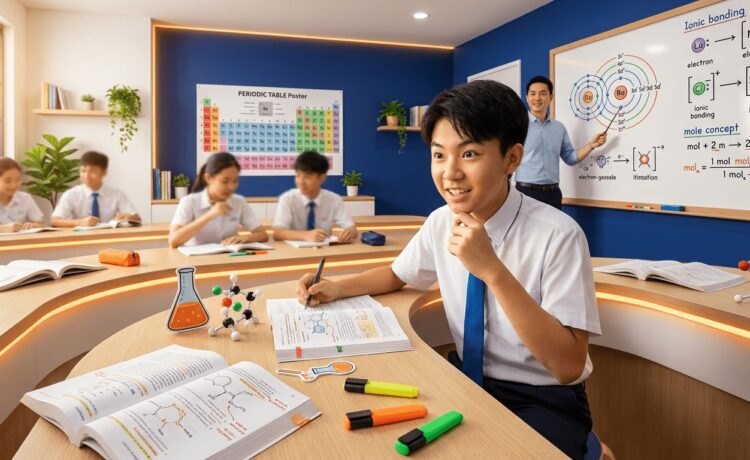
A student may spend four hours revising Physics on Sunday and still struggle to recall the same ideas by Thursday. The problem is not always effort. It is often the timing and method of revision. Families considering Top Physics Tuition Potong Pasir should look for a learning system that brings concepts back repeatedly over time, instead of relying on one heavy session immediately before a test.
Weekend cramming can create a strong feeling of familiarity because the student sees the same notes and question types many times in a short period. Familiarity, however, is not the same as being able to retrieve and apply knowledge several days later. Spaced retrieval deliberately interrupts that comfort. It asks the student to recall ideas after some forgetting has begun, which makes weaknesses visible and gives the brain another opportunity to reconstruct the learning.
Why Cramming Feels More Effective Than It Is
Cramming produces quick short-term improvement. After reading a formula several times and completing similar questions, the student can often answer the next question correctly. This success feels convincing because the material is still active in working memory.
The problem appears later. When the same concept returns in a different chapter, a mixed paper or an examination, the supporting cues are gone. The student remembers seeing the solution but cannot reproduce the reasoning.
Physics is especially vulnerable to this problem because students may memorise equations without learning the conditions under which they apply. A Sunday session on forces can make every force question look straightforward because the chapter is already known. Two weeks later, a mixed question may require the student to decide whether the situation is controlled by force, energy or momentum. Cramming has not necessarily trained that decision.
Retrieval Is Different from Review
Review means looking at information again. Retrieval means attempting to produce it without looking.
Both have a role, but retrieval gives more honest evidence. A student who rereads a page on electromagnetic induction may feel that every sentence is understood. When the notes are closed, the student may be unable to explain what changes, which effect is produced or how the direction is determined.
A retrieval task can be simple. The student may write the main principle, redraw a diagram, explain a graph or list the steps for solving a type of problem. The answer is then checked against the notes.
The value lies partly in the attempt. Even an incomplete recall shows exactly what needs attention. Passive review can hide those gaps because the correct information is always visible.
Spacing Makes Retrieval Productive
Retrieving a concept immediately after studying it is usually easy. Waiting for a period before trying again makes the task more demanding.
This difficulty is useful when it remains manageable. The student has to reconstruct the relationship instead of repeating it from short-term memory. Each successful return strengthens access to the idea.
A practical Physics schedule might revisit a concept on the same day, two or three days later, one week later and again in a mixed set after a longer interval. The exact spacing can vary. The important point is that the student returns before the concept is completely abandoned but after the answer is no longer effortless.
Students should not interpret temporary forgetting as failure. The small struggle to recall is part of what makes the next retrieval stronger.
A Three-Layer Weekly Routine
Spaced retrieval does not require an elaborate app or a large stack of flashcards. It can be built into ordinary homework.
The first layer is a short recall after the lesson. The student closes the notes and writes the main idea, one important equation with its meaning and one uncertainty.
The second layer occurs later in the week. The student attempts a few questions without being told the exact method. Any mistake is corrected and recorded.
The third layer happens during a later mixed session. The topic appears among other chapters, so the student must recognise when it is relevant.
This structure keeps revision active without turning every evening into a long Physics session.
Retrieval Must Include More Than Formulas
Some students interpret retrieval practice as memorising equations from flashcards. Formula recall is useful, but Physics knowledge includes much more.
Students need to retrieve definitions, diagrams, graph meanings, assumptions, units, explanation chains and decision rules. They should also retrieve common errors and how to prevent them.
For example, recalling the equation for wave speed is less useful if the student cannot distinguish frequency from period or interpret a displacement-distance graph. A strong retrieval prompt might ask, “What information would show that two points are in phase?” or “When would the wave-speed equation not be enough to answer the question?”
The best prompts require meaning, not only symbols.
Use Questions That Change the Surface Context
Spaced retrieval becomes stronger when the later question does not look identical to the first one.
A student may initially learn pressure through a block resting on a surface. The later question might involve a person wearing snowshoes or a liquid pressure situation. The principle is related, but the student must identify how the context changes the relevant quantities.
This variation prevents memorised procedures from being mistaken for understanding. It also prepares students for examination questions that use familiar ideas in unfamiliar settings.
The difficulty should increase gradually. If every return uses an extremely complex question, the student may not know whether the failure came from forgetting the concept or from the new context.
Build Spacing Around Actual Errors
An error log can become the scheduling tool.
When a student makes an important mistake, record a retry date. The first retry may happen after two days. If successful, a changed question can return the following week. If the same error appears again, the interval should shorten and the concept may need reteaching.
This is more purposeful than revising every topic on the same fixed cycle. Secure concepts require occasional maintenance, while unstable concepts need earlier and more frequent retrieval.
Students should remove or reduce prompts over time. The first retry may include a diagram or hint. A later retry should require the student to construct the representation independently.
Combine Spacing with Interleaving
Spacing determines when a topic returns. Interleaving changes what appears alongside it.
Instead of completing ten questions from one chapter, a student may attempt a short set involving forces, energy, waves and electricity. The chapter is not announced, so the student must select the principle.
This makes practice feel slower because fewer questions are completed automatically. It is also more representative of examination conditions.
Interleaving should not replace focused practice when a concept is new. Students first need enough understanding to attempt the method. Once the basic idea is stable, mixed practice helps it become selectable.
What a Realistic School-Week Schedule Looks Like
A workable routine should survive school, travel, CCA and other subjects.
On the lesson day, ten to fifteen minutes may be enough to retrieve the main concept. Two days later, the student can complete a focused 30-minute question session. At the weekend, one mixed set can bring back the topic with earlier chapters.
The following week, the concept appears again through one corrected question or a timed section.
This approach may use less total time than cramming because the sessions begin with a clear task. The student is not spending the first hour rereading the entire chapter to remember where the work began.
How to Know Whether Spaced Retrieval Is Working
Progress should be measured by what the student can produce after a delay.
Useful signs include recalling the main relationship without notes, selecting the correct method in a mixed set, explaining a previous misconception and solving a changed question with fewer prompts.
The student may initially feel less confident because retrieval exposes gaps. This is not necessarily a negative result. A truthful sense of what is known is more useful than the confidence created by familiar pages.
Over several weeks, the student should notice that earlier topics are easier to reactivate and that revision before tests requires less complete relearning.
Common Ways Students Weaken the Method
One mistake is checking the answer too quickly. If the student looks after a few seconds of hesitation, the task becomes recognition again.
Another is using only flashcards with one-word answers. Physics requires connected reasoning, diagrams and calculations, so retrieval tasks should vary.
Students may also create an unrealistic schedule containing dozens of daily reviews. The system then becomes another backlog. It is better to retrieve fewer high-value concepts consistently.
Finally, some students never return to errors after the first successful retry. A changed question after a longer interval is needed to confirm that the learning can transfer.
How Tuition Can Support the Cycle
Tuition can provide clear explanations, diagnostic questions and suitable delayed practice, but the spacing has to continue between lessons.
A tutor can identify which concepts should return, create questions with changed contexts and reduce prompts as the student improves. The student remains responsible for the short retrieval sessions that keep the learning active during the week.
Students attending TGC ACADEMY in Potong Pasir can use lesson feedback to decide what enters the next retrieval cycle. This keeps tuition connected to independent revision rather than making the weekly class the only time Physics is actively recalled.
Frequently Asked Questions
Q. Is spaced retrieval the same as doing more homework?
Ans. No. It changes when and how students practise. Short, purposeful returns can replace some long rereading sessions and may use time more efficiently.
Q. How long should a retrieval session last?
Ans. It can be as short as ten minutes when the task is clear. Longer sessions are useful for mixed questions and calculations, but every return does not need to become a full revision block.
Q. What should a student do after failing to recall a concept?
Ans. Check the missing information, explain it clearly, then attempt retrieval again after a shorter interval. The failed attempt provides useful evidence about what needs strengthening.
Q. Can students use flashcards for Physics?
Ans. Yes, but flashcards should include concepts, diagrams, assumptions and decision prompts, not only formula names or isolated definitions.
Q. Is weekend revision still useful?
Ans. Yes. The problem is relying on the weekend as the only contact with Physics. Weekend sessions work better when shorter retrieval has already happened during the week.
Replace the Revision Marathon with a Learning Rhythm
Physics is easier to retain when ideas return before they disappear completely. Spaced retrieval creates a rhythm of recall, application, correction and later reuse.
The method may feel less smooth than cramming because it reveals uncertainty. That is exactly why it is valuable. Students learn what they can actually produce without support, and each return gives them another chance to make the knowledge more durable and usable.
TGC Academy Potong Pasir Location Details
Business Name: TGC Academy (Potong Pasir)
Address: 107 Potong Pasir Ave 1, #01-K1, Singapore 350107
Phone: +65 8920 0792
Email: [email protected]
Website: https://www.tgc.sg/
Operating Hours:
Monday: 3:00 PM to 10:00 PM
Tuesday: Closed
Wednesday: 3:00 PM to 10:00 PM
Thursday: 3:00 PM to 10:00 PM
Friday: 3:00 PM to 10:00 PM
Saturday: 3:00 PM to 8:00 PM
Sunday: Closed